
Container Gardens
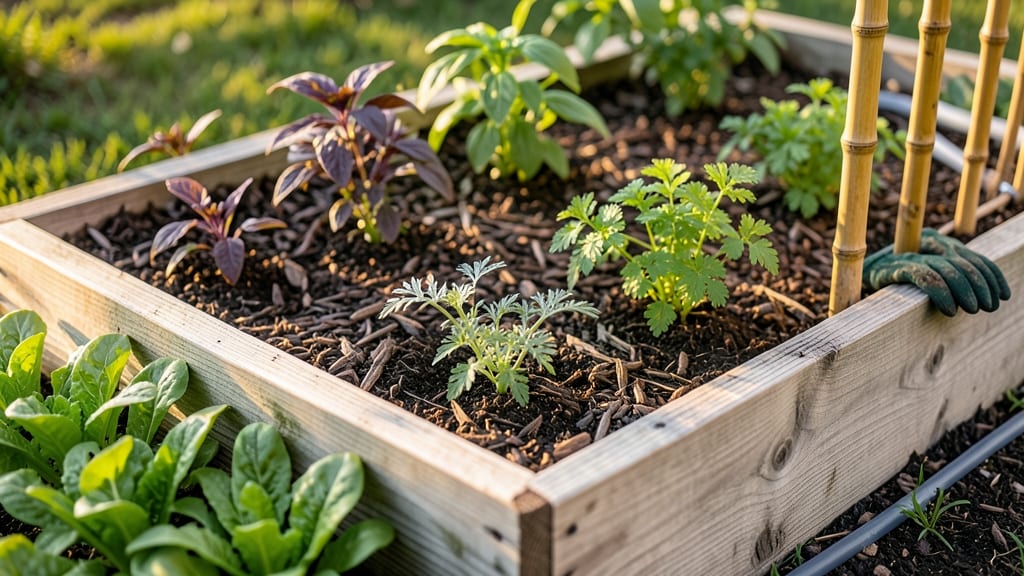
A 2x8 raised bed is the perfect size for small-space gardeners who want big results—think 16 square feet of growing power in just one compact footprint.
Picture this: a tiny backyard, a balcony, or even a patio crammed with tomatoes, peppers, and herbs—all within arm’s reach. That’s the magic of a 2x8 bed, where every inch counts and you avoid the hassle of bending over a ground-level plot.
Whether you’re a beginner or a space-saving pro, this size strikes the balance between productivity and ease. You’ll learn how to maximize vertical growth, choose the right crops, and design a layout that works for both veggies and flowers.
From material choices to plant spacing, I’ll walk you through everything you need to turn a 2x8 raised bed into your most efficient (and beautiful) garden yet.
2x8 raised bed dimensions: exact measurements and space optimization
A 2x8 raised bed might measure 2 feet wide by 8 feet long on the outside, but the usable internal space depends on lumber thickness. Most 2x6 boards are actually 1.5 inches thick, so your planting area shrinks by 3 inches total (1.5" on each side).
That means your usable growing space is 1.5 feet wide by 7.75 feet long—or about 11.6 sq ft instead of the expected 16 sq ft.
This discrepancy happens because lumber dimensions are nominal sizes (what they should be) rather than actual measurements. A 2x8 board is 7.25 inches wide and 1.5 inches thick, not 2x8 inches. Always account for this when planning your plant spacing or you’ll end up with a cramped garden.
Here’s how to calculate your true usable space:
- Subtract 1.5 inches from each side for the board thickness.
- Subtract 0.75 inches from the length for corner joints (if using standard construction).
- For a 2x8 bed, this leaves you with 1.25 feet width x 7.5 feet length—or roughly 9.4 sq ft of plantable area.
To maximize your 16 sq ft potential, use 1x12 boards (actual width: 11.25 inches) for the sides. This gives you 1 foot width x 7.75 feet length—a full 7.75 sq ft of usable space per side.
For a 2x8 bed, this means 15.5 sq ft of growing room, much closer to the expected 16 sq ft.
Another trick is to build your bed deeper (12–18 inches) to accommodate vertical growing. Trellises for pole beans, cucumbers, or tomatoes can turn a 2x8 bed into a 3D garden, doubling your yield without expanding your footprint.
Common mistakes to avoid:
- Ignoring lumber thickness—always measure your boards before planning.
- Skipping drainage holes—without them, your bed will waterlog.
- Overcrowding plants—stick to square-foot gardening guidelines to prevent competition.
For high-yield crops like tomatoes or peppers, use container gardening within your bed. Place 5-gallon buckets or fabric grow bags in the corners to grow 1–2 plants per container. This frees up space for leafy greens or herbs in the main area.
Pro tip: If you’re using cedar or redwood, account for 0.5-inch gaps between boards for airflow. This reduces usable width further but prevents rot. For maximum space, use pressure-treated lumber with tight joints (but
Best vegetables for a 2x8 raised bed: layouts for maximum productivity
A 2x8 raised bed gives you 16 square feet of growing space—plenty for a bounty if you plan carefully. The key is choosing compact, high-yield crops and arranging them efficiently.
I’ve tested two layouts: square-foot gardening (intensive planting) and row planting (traditional spacing) to show which works best for small spaces.
Square-foot gardening maximizes every inch by planting 16 basil plants, 9 lettuce heads, or 4 tomato plants in a single square foot. Row planting, meanwhile, prioritizes airflow and easier maintenance but uses space more sparsely.
For a 2x8 bed, I recommend a hybrid approach—using square-foot for herbs and greens while dedicating rows to larger crops like tomatoes or peppers.
Comparison Table: Square-Foot vs. Row Planting for a 2x8 Raised Bed
| Method | Best For | Example Layout (2x8 Bed) | Yield | Pros | Cons |
|---|---|---|---|---|---|
| Square-Foot Gardening | Herbs, greens, radishes |
|
High (dense planting) | Maximizes space, great for small beds | Requires frequent thinning, less airflow |
| Row Planting | Tomatoes, peppers, bush beans |
|
Moderate (spaced out) | Better airflow, easier maintenance | Uses space less efficiently |
| Hybrid Approach | Mixed crops |
|
Balanced (high + moderate) | Best of both worlds, flexible | Requires planning |
For my 2x8 raised bed, I use a hybrid layout: square-foot gardening on one half for basil, lettuce, and radishes, while the other half follows row planting for tomatoes and peppers.
This gives me the best of both worlds—high yields from dense planting and easier access for larger crops. I also add a vertical trellis along one side for cucumbers or beans to utilize vertical space.
When spacing plants, always follow these key rules:
- Leafy greens (lettuce, spinach): 4-6 inches apart
- Herbs (basil, parsley): 6-12 inches apart
- Tomatoes/peppers: 18-24 inches apart
- Root veggies (radishes, carrots): 2-3 inches apart
Proper spacing prevents competition and reduces disease risk.
If you’re short on space, prioritize fast-growing, high-value crops like bush beans, radishes, or green onions. These mature quickly, allowing you to rotate crops and maximize your 2x8 raised bed’s productivity throughout the season. Just remember: less is more—overcrowding leads to stunted growth and pests.
🌱