
Tools
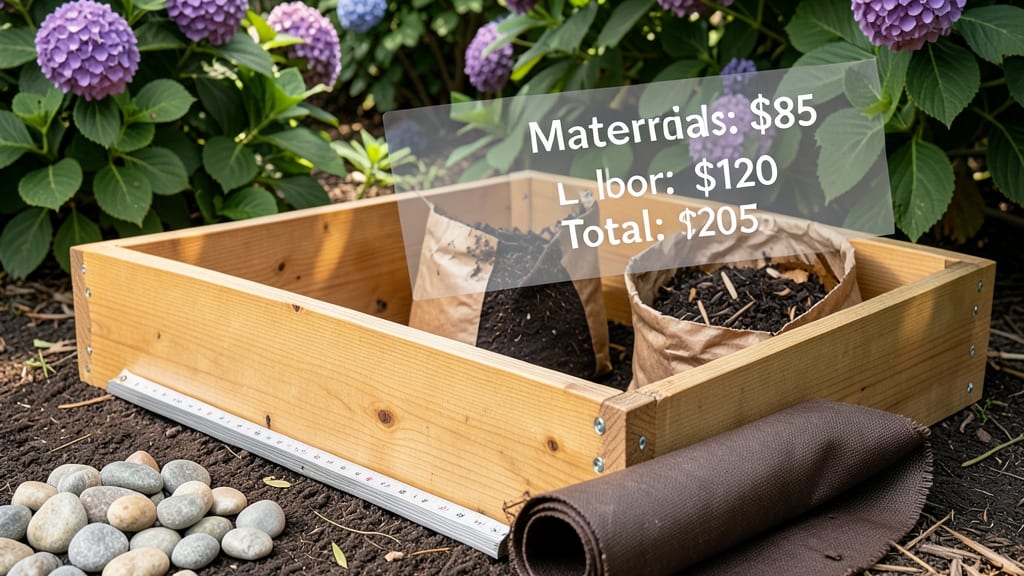
Understanding garden bed costs helps you plan your project: in-ground beds require minimal upfront investment ($10–$50), while raised beds typically cost $100–$1,200, and custom designs can easily surpass $2,000. Your final price depends on materials, dimensions, and whether you DIY or hire help.
Your choice of materials makes a huge difference—cedar raised beds run $300–$800 due to natural rot resistance, while pressure-treated lumber cuts costs to $150–$500 but may need sealing every few years. 🌱 In-ground beds save money by using existing soil, but adding compost or topsoil can push costs up to $50–$200 for a 4'x8' area.
Labor adds another layer: professional installation for raised beds often costs $100–$300 extra, depending on your location and complexity.
For budget-conscious gardeners, DIY in-ground beds are the most affordable, but they require more physical effort and may need soil amendments. Raised beds offer better control over soil quality and drainage but come with higher material costs.
If you're working with limited space, consider container beds—these can start as low as $20–$100 for small, portable options, though they won't support large plants.
💡 In This Article
- Material and Size Factors Affecting Garden Bed Pricing
- Budget Breakdown: DIY vs Store-Bought Raised Beds
Material and size factors affecting garden bed pricing
The foundation of your garden bed costs starts with the materials you choose. Cedar wood, prized for its natural rot resistance and aromatic appeal, typically costs $3–$6 per linear foot for raised bed frames.
A 4'x8' cedar raised bed will set you back around $600–$900 before soil, while pressure-treated lumber cuts costs to $1.50–$3 per foot, making the same bed $300–$500. The trade-off?
Cedar lasts 10–15 years without treatment, while pressure-treated wood may need sealing every 2–3 years to prevent warping or chemical leaching.
Size directly impacts both material costs and soil requirements. A standard 4'x8' raised bed contains about 0.5 cubic yards of soil, costing $15–$40 for quality topsoil or compost blends. Scaling up to 8'x12' doubles these costs while requiring 1 cubic yard of soil.
In-ground beds minimize material costs but may need $50–$200 in soil amendments like compost or sand for proper drainage. The key difference? Raised beds let you customize soil depth (12–18 inches is ideal for most plants) without fighting compacted native soil.
Hardware and accessories add up quickly. Corner brackets, screws, and drainage systems (like landscape fabric or gravel layers) can cost $20–$50 for a basic setup. For container beds, durable plastic or galvanized steel options start at $20–$100 but offer portability.
Labor becomes the wild card: DIY assembly saves money, but professional installation for raised beds typically runs $100–$300, depending on local rates and bed complexity. In urban areas, these costs can climb 30–50% higher due to higher demand for skilled labor.
Don't overlook long-term maintenance costs. Cedar beds require minimal upkeep beyond occasional sealing, while pressure-treated wood may need $20–$50 every few years for stain or sealant. Container beds often have shorter lifespans (5–10 years) due to UV degradation unless made from high-grade materials.
The size of your bed also affects maintenance time—larger beds mean more weeding, watering, and soil replenishment over time. For example, a 4'x8' raised bed might require 2–3 extra hours of maintenance per month compared to an in-ground bed of the same size.
Location plays a surprising role in pricing. In rural areas, you might pay $15–$30 per cubic yard for topsoil, while urban centers can charge $40–$70 due to delivery fees. Regional lumber costs vary too—cedar prices in the Pacific Northwest are 20–30% lower than in the Midwest due to local mills.
Always check for sales at big-box stores or local sawmills, where raised bed kits can drop $50–$100 off retail prices. The right materials and smart sizing can turn a $1,000 project into a $600 one without sacrificing quality.
For the most cost-effective garden bed, consider these trade-offs: In-ground beds save money upfront but require more physical labor and soil prep. Raised beds offer better control over growing conditions but come with higher material costs.
Container beds are the most portable but have limited capacity. The sweet spot? A 4'x8' cedar raised bed with 12–18 inches of soil—it balances cost, durability, and growing potential for most home gardeners.