
Light Requirements
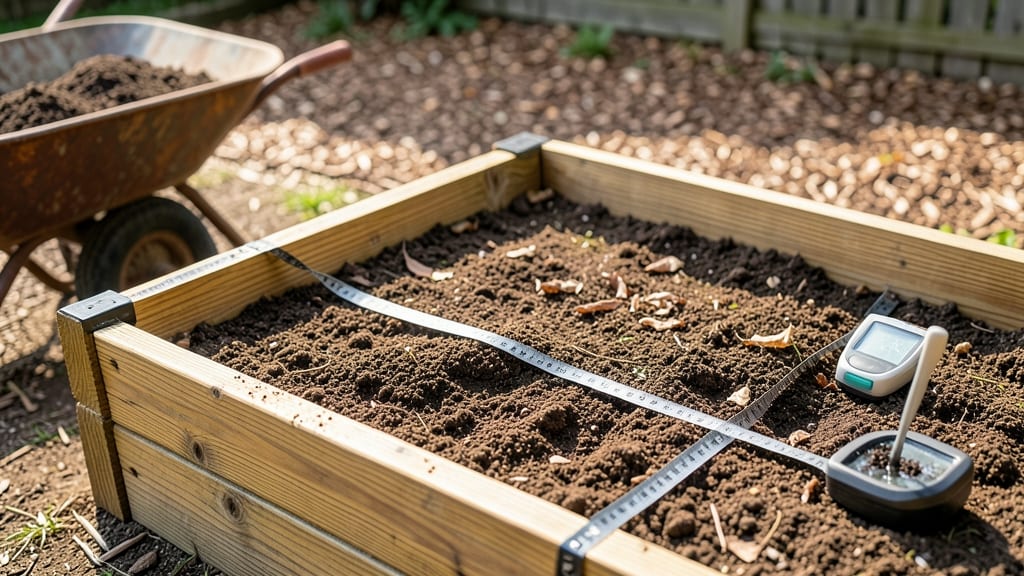
For an 8x4x2 raised garden bed, you'll need 64 cubic feet of soil to fill it completely. Always add 10-15% extra to account for soil settling and drainage layers like gravel or fabric.
Calculating the exact soil volume for your 8x4x2 raised garden bed starts with multiplying the dimensions: 8 feet (length) × 4 feet (width) × 2 feet (height) equals 64 cubic feet. 🌱 However, real-world conditions require adjustments—soil naturally compacts over time, and you'll need space for drainage layers.
I recommend buying 70-75 cubic feet to ensure you have enough, especially if you're mixing in compost or other amendments. This extra volume also helps if you decide to add mulch later for moisture retention.
Another key factor is the type of soil you choose. Topsoil alone won't provide optimal growing conditions—most gardeners blend it with compost or peat moss to improve drainage and fertility.
For a 8x4x2 bed, you might use 50% topsoil, 30% compost, and 20% peat moss, which means adjusting your bulk purchase quantities accordingly.
Buying in bulk (by the yard) is often more cost-effective, but be sure to calculate how many cubic yards you'll need—64 cubic feet equals about 2.4 cubic yards, so rounding up to 3 cubic yards gives you that extra buffer.
💡 In This Article
- Calculating Raised Garden Bed Soil Volume: Dimensions and Math
- Best Soil Mix for 8x4x2 Raised Beds: Quantity and Types
Calculating raised garden bed soil volume: dimensions and math
The formula for calculating soil volume in a raised garden bed is straightforward: multiply length × width × height. For an 8x4x2 bed, that’s 8 × 4 × 2 = 64 cubic feet. However, this is the theoretical maximum—real-world conditions introduce variables that require adjustments.
Soil particles naturally settle and compress over time, especially under foot traffic or plant roots, which can reduce usable volume by 10-20%. This means your 64 cubic feet of loose soil may shrink to 50-55 cubic feet once compacted. 🌱
Drainage layers add another layer of complexity. Many gardeners include a 2-4 inch gravel or rock layer at the bottom for water drainage, which occupies space that wouldn’t hold soil. For an 8x4x2 bed, this could mean losing 3-6 cubic feet of soil volume.
Additionally, some builders use landscape fabric to separate the drainage layer from the soil, which doesn’t take up space but still reduces the effective fill capacity. Always account for these adjustments by purchasing 10-15% more soil than your calculated volume.
Depth also plays a critical role in soil calculations. While a 2-foot height is standard for many raised beds, deeper beds (like 4-foot or 6-foot versions) require significantly more soil. For example, a 8x4x4 bed would need 128 cubic feet of soil—double the volume of an 8x4x2 bed.
This is why many gardeners start with shallower beds (12-18 inches) and expand vertically over time, as deeper beds require heavier materials and more soil to fill. 💫
Another factor to consider is soil type. Loose, fluffy soil (like a mix of topsoil and compost) will settle more than dense, clay-heavy soil. If you’re using a 50% topsoil, 30% compost, 20% peat moss blend, expect even more settling due to the organic matter breaking down.
To mitigate this, some gardeners pre-moisten the soil before filling the bed, which helps it compact more evenly and reduces future settling. Always test your soil blend in a small container first to gauge how much it compresses over a few weeks.
For practical purposes, rounding up is always safer. A 70-75 cubic feet purchase for an 8x4x2 bed ensures you have enough soil, even after accounting for settling and drainage. If you’re buying in bulk (by the cubic yard), remember that 1 cubic yard = 27 cubic feet.
So, 64 cubic feet is roughly 2.4 cubic yards, meaning you’d want to purchase 3 cubic yards to stay ahead of settling and drainage needs. This extra volume also comes in handy if you decide to add mulch or adjust your planting depth later. ✨
Pro tip: Measure your soil in layers as you fill the bed. Start with the drainage layer (if using), then add soil in 6-inch increments, tamping it down lightly with a board or shovel to simulate settling.
This method helps you visualize how much soil you’re using and adjusts your purchases accordingly. It’s also a great way to spot-check your calculations before committing to a full bulk order.